


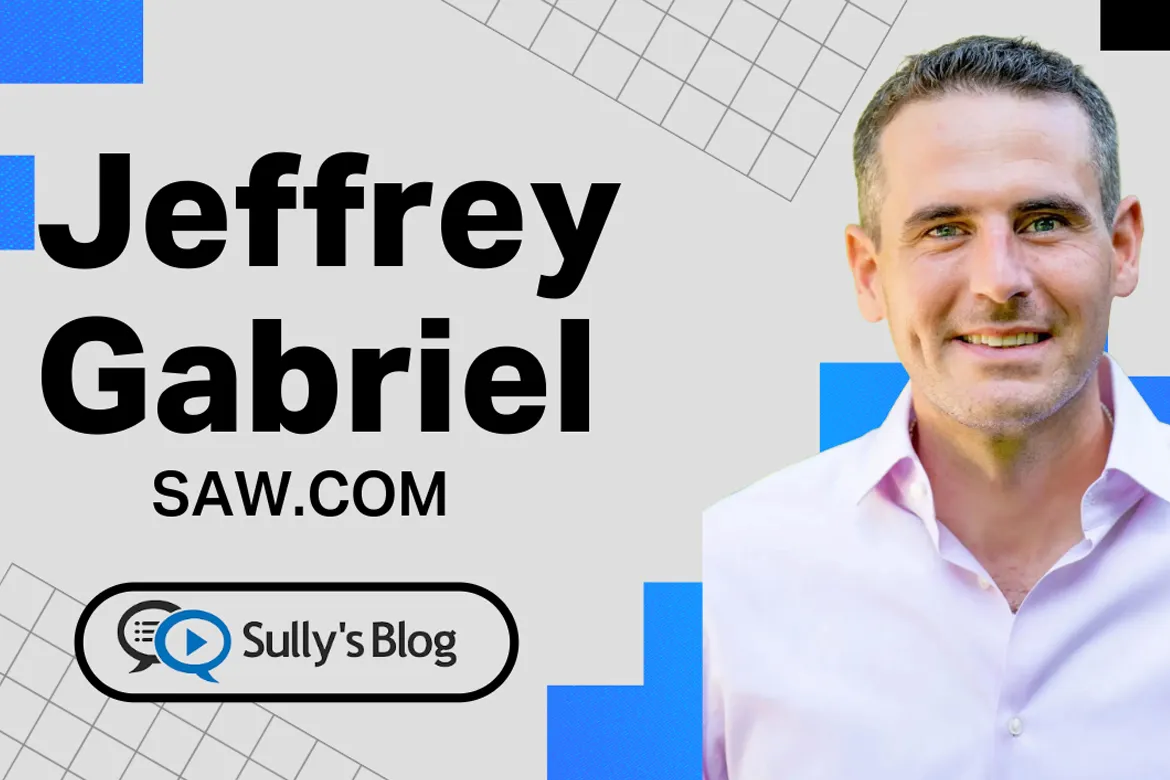
I've known Jeffrey Gabriel's name for a while now. If you've been in the domain space for any amount of time, you probably have too. He's the guy who sold Sex.com for $13 million and held the Guinness World Record for tI've known Jeffrey Gabriel's name for a while now. If you've been in the domain space for any amount of time, you probably have too. He's the guy who sold Sex.com for $13 million and held the Guinness World Record for the highest .com domain sale. He spent seven years at Uniregistry working under Frank Schilling, contributed to over $550 million in domain transactions, and then in 2019 he walked away from what he calls his dream job to build Saw.com from scratch.
That last part is what made me want to do this interview. Leaving a sure thing to start over is not something most people in this industry do. Jeffrey didn't just want to keep brokering deals for someone else. He wanted to build his own shop, keep the team small, and do it on his own terms. Saw.com isn't trying to be the biggest brokerage in the space. It's trying to be the one that actually picks up the phone.
I reached out to Jeffrey because I wanted to get past the resume and into how he actually thinks about deals, negotiations, and what separates brokers who close from brokers who just send emails. His answers did not disappoint.
Mike: What was the moment you realized it was time to build Saw.com? What was the driving force?
Jeffrey: I've always had an entrepreneurial spirit, even long before entering the domain industry. After spending seven great years at Uniregistry, I was approaching 40, and I felt it was now or never.
Mike: When a buyer says, "That domain is too expensive," what is the best response, and what is the worst response?
Jeffrey: There are really two kinds of buyers: those who will never become buyers, and those who are interested and could become buyers. When someone appears qualified, I believe it's critical to dig a little deeper to understand where they're coming from.
That's why I still rely on something simple: the phone or Zoom. I introduce myself, explain what Saw.com does, share my background and years in the industry, maybe provide some context about the domain and the owner, and then I turn the conversation over to the buyer. Ideally, they open up about their business, their goals, and where they are in their journey.
At that point, I'm listening intently, not just to what they say, but to what it tells me about their stage, their plans, and their constraints. When the conversation turns to price, I tailor the discussion to their situation. I introduce options, possibilities, real-world stories, and practical realities that might help this investment make sense to them. There are countless reasons why the price is too high. Hopefully, we get to the bottom of it and overcome it.
No silver bullet works every time. But there is a common theme: people don't want to be sold; they want you to solve their problem(s). Our job is to solve them, build relationships, and educate. Hopefully, this will point them toward success.
Mike: What separates a broker who closes from a broker who just follows up?
Jeffrey: What separates the wheat from the chaff is simple: calling, connecting, educating, and having the conversation. This is a significant decision/investment for most buyers.
When I've managed brokers, the red flag is effort allocation. If a broker treats a newly funded CEO the same way they treat an unqualified lead, with equal effort and generic communication, it's probably time for that broker to be successful somewhere else. I'd rather see five calls, emails, and real follow-up on the qualified lead, and maybe a light automated touch on the unqualified one, or nothing.
And if you don't have enough to work on, go get more business. Call past buyers. Call our sellers and get some names to sell. Call newly funded companies and tell them to hire you. Write an article. Get your ass out there.
Mike: How do you set expectations with a client when the owner's price is unrealistic or the owner is unresponsive?
Jeffrey: For every buyer-broker opportunity I personally work on, a call is mandatory. I need to explain who I am, who we are, and understand their business. I want to know if they've inquired before, hired someone else, what was said, what was offered, and when. All that matters.
From there, I do my homework: ownership history, past use, and where I realistically think the deal will land. I give the buyer a clear idea of the cost and outline the next steps so there are no surprises.
If someone won't spend 10 minutes on the phone, there's no reason to believe they'll wire $20k, $30k, or $50k later. Based on their answers, the domain's history, and their budget, I can usually tell them upfront whether the seller is likely to engage. I try to paint that picture early. Giving bad news isn't fun, but facts are facts. The no-response outcome or the very high price is one you can sometimes see a mile away.
Mike: What negotiation tactic do you see buyers overuse that actually hurts their leverage?
Jeffrey: Buyers who label sellers as squatters and begin the relationship with legal threats and demands are starting at a disadvantage…(Oh, why did you have to go and do that!) Even after being informed that the seller owned the domain long before their business existed, they often continue to make outlandish demands. I always wonder where they are getting this information to think that acting this way is a good idea.
Mike: What negotiation tactic do sellers overuse that kills deals unnecessarily?
Jeffrey: Sellers who do not respond or give straight answers.
Mike: What is the biggest operational bottleneck in domain deals that outsiders never see?
Jeffrey: Nothing specific jumps out, but I've seen just about everything: sellers who've passed away, sellers who will only sell to certain groups of people, domains tied up in divorces, domains stolen while already in escrow, buyers whose partners outbid them on another platform after terms were agreed, employees trying to buy and flip a domain back to their own company, domains caught in bankruptcy, sellers changing their minds at the last minute, buyers changing their minds, buyer's lawyer finding a trademark issue in the 11th hour, the board disallowing the offer that was made and accepted, buyers inquiring under multiple identities across different platforms, a buyer getting bit by a spider, lawsuits being filed, the government not permitting the buyer to buy, war, natural disaster and much more.
Mike: What role does your appraisal tooling play today, and what do you want it to become over the next year or two?
Jeffrey: Our domain appraisal tool was built to help buyers answer a simple question: why? Why does one domain cost this much while another costs that much?
Is it perfect? No, and it never will be. I could dedicate my life to refining the algorithm, and it still wouldn't be flawless. Over the next year or two, my goal is to make it more consistent, particularly for AI-related domains and new gTLDs. To do that, we need more data, especially comparable sales.
Mike: What is a deal you are proud of, not because of the price, but because of how it was handled?
Jeffrey: I was working with a startup that wouldn't need the domain for six to twelve months. All they really wanted was to understand the price and have me check back in three to six months if the project actually moved forward. When I asked what they'd be comfortable paying now, the answer was essentially nothing, but if necessary, they could put up $3,000 to $5,000. We expected the full price to land in the $30,000 to $40,000 range.
I proposed a purchase option to the seller's representative. At first, the seller wasn't interested. But I explained that if he passed, the buyer would likely keep shopping, and if they found a comparable domain at a similar or lower price, the opportunity would be gone. That changed the conversation.
The seller agreed to take the domain off the market. We structured the deal through Escrow.com as a simple two-step payment plan: a small upfront payment and a final payment months later. If the business moved forward, the buyer could complete the purchase at the pre-agreed price. If it didn't, they walked away having spent only a few thousand dollars. It was low risk for the buyer, fair compensation for the seller, and it worked out well for everyone. The domain was workstation.ai
Mike: You are not only a domainer, but an entrepreneur. What advice, mentors or experiences have molded you into the person you are today? What value do you place on that?
Jeffrey: "I stood on the shoulders of giants," Isaac Newton once said. I've been incredibly fortunate to have supportive parents, a great wife, family, and friends. Before entering the domain industry, I learned from some of the best salespeople I've ever met and carried those lessons with me throughout my career.
I also had the rare opportunity to learn from the most successful domainer of all time, Frank Schilling, and his right-hand man, Vern Jurovich. Very few people get teachers like that, and I don't take it lightly.
As both an entrepreneur and a salesperson, I'll say what I've always said: hard work pays off. Ignore the talk about hacks and shortcuts. Put your head down, do the work, and grind.