



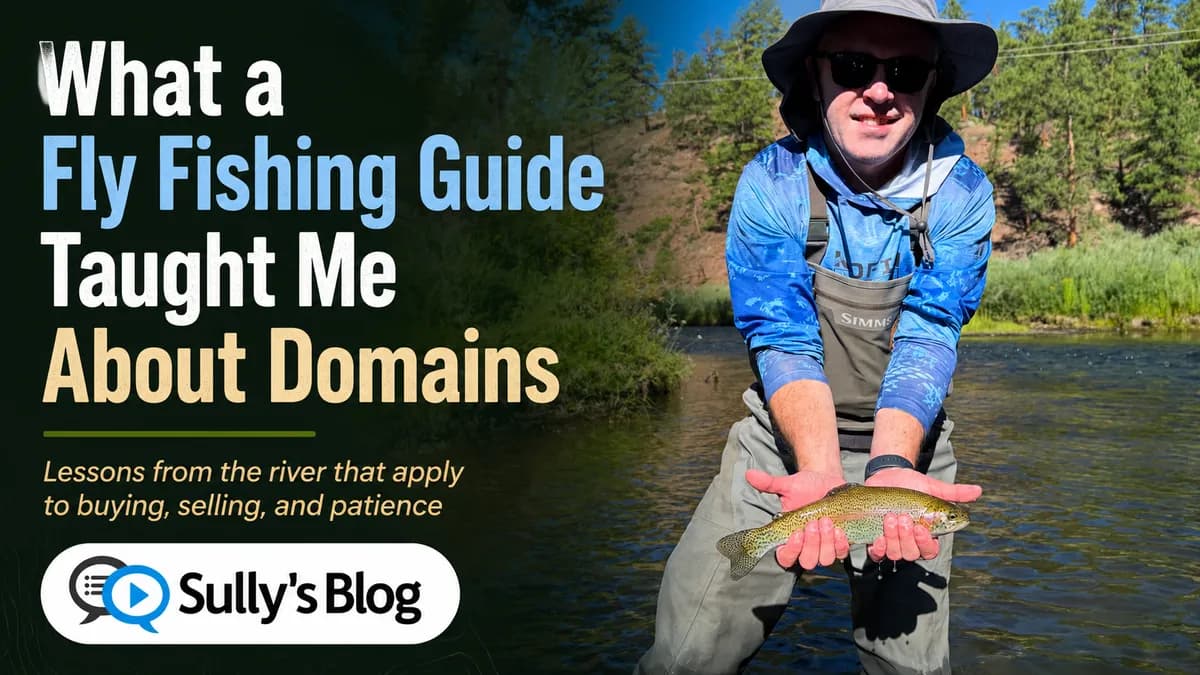
I spent part of a day on the South Platte in Colorado last week, fly fishing for the first time in my life, and I was bad at it in a way I didn't expect.
Not bad like I couldn't cast. Bad like I was doing eleven things nearly correctly and had no idea which one was costing me.
We'd hired a guide, which was the only smart decision I made all day. He'd stand a few feet off my shoulder and say something small. Move your hand back. Let it drift another second before you pick up. Mend upstream. Watch that seam, not the middle. None of it sounded like much. I'd make the adjustment and the whole thing would change, sometimes on the next cast.
Somewhere in there I started thinking about domain names, which probably says more about me than about fly fishing.
The first thing that got me was how much of the day was just about where we were standing.
You can have the right rod and the right fly and a decent cast, and if there's nothing holding in that water you're going to have a lovely afternoon and catch nothing. Our guide barely stopped moving us. He'd look at a stretch I thought was fine, shake his head, and walk us forty yards downstream to something that looked identical to me.
That's buying domains, and it took me way too long to learn it.
There are a lot of good names that are never going to sell. Short, clean, memorable, five uses you can rattle off. None of that is the question. The question is whether there's anybody standing on the other end of it with a checkbook, and most of the time the honest answer is no.
I care much less now about whether I like a name. I care whether I can name the company that wants it.
But the part that stuck with me was the small corrections.
Without the guide I'd have spent six hours doing everything almost right, gone home, and told people the fish weren't biting. That's the dangerous part. Almost right feels right. There's no alarm that goes off.
Domain investing is full of that.
The gap between mediocre results and decent ones usually isn't a strategy change. It's that you finally price a name at $4,995 instead of $25,000 because you got honest about who's buying it. Or you put an actual BIN on the lander instead of making people ask. Or you cut the first three paragraphs of your outbound email, the ones explaining who you are, which nobody has ever read. Or you spend five more minutes finding the person who'd actually use the name instead of firing it at info@.
Small stuff. So was moving my hand six inches.
There's also something to be said for standing next to somebody who's already put in the thousands of hours. Our guide looked at that river and saw structure. I saw moving water. He'd point at a spot and explain what was underneath it and why a trout would sit there instead of two feet to the left, and I'd nod like I could see it. I couldn't.
Domain investors get that same vision eventually, and it's mostly unglamorous. You learn which names have a buyer and which ones just photograph well in a registrar search. You learn what people actually pay versus what gets reported. You learn how long you'll be sitting on something before the right inquiry shows up, which is usually longer than you want to hear.
None of that makes you right. It just makes you wrong less expensively.
The other lesson came from everything I felt on the line that wasn't a fish.
Rocks, mostly. Weeds. The current doing something. I set the hook hard on nothing at least a dozen times and my guide was polite about it for the first six.
Same thing happens in the inbox. Somebody hits the lander five times in a day. Somebody asks for a price. Somebody offers $200 and you start doing math on the counter. Somebody sends "what's your lowest price" and you're already deciding what you'll do with the money.
Then nothing. That's the whole story, most weeks.
You stop reacting to every twitch eventually. You keep the line in the water.
There were long stretches on that river where absolutely nothing happened, which is apparently normal and which I found harder than I expected. Then it turned on for about twenty minutes and everybody caught something.
A name can sit for four years and then get an inquiry from exactly the company you pictured when you bought it. The temptation in year three is always to do something. Drop the price, move marketplaces, rebuild the lander, send another round of outbound. Sometimes that's the right call. Sometimes you're just moving because standing still is uncomfortable.
I'm not going to pretend one day on the South Platte made me a fly fisherman. I caught three fish, and I'd bet the guide could tell you exactly which corrections were responsible for them.
But I keep coming back to how little the adjustments were, and how long I would've gone without knowing.
Makes me wonder what I'm doing almost right in my portfolio, and who's not standing there to tell me.