


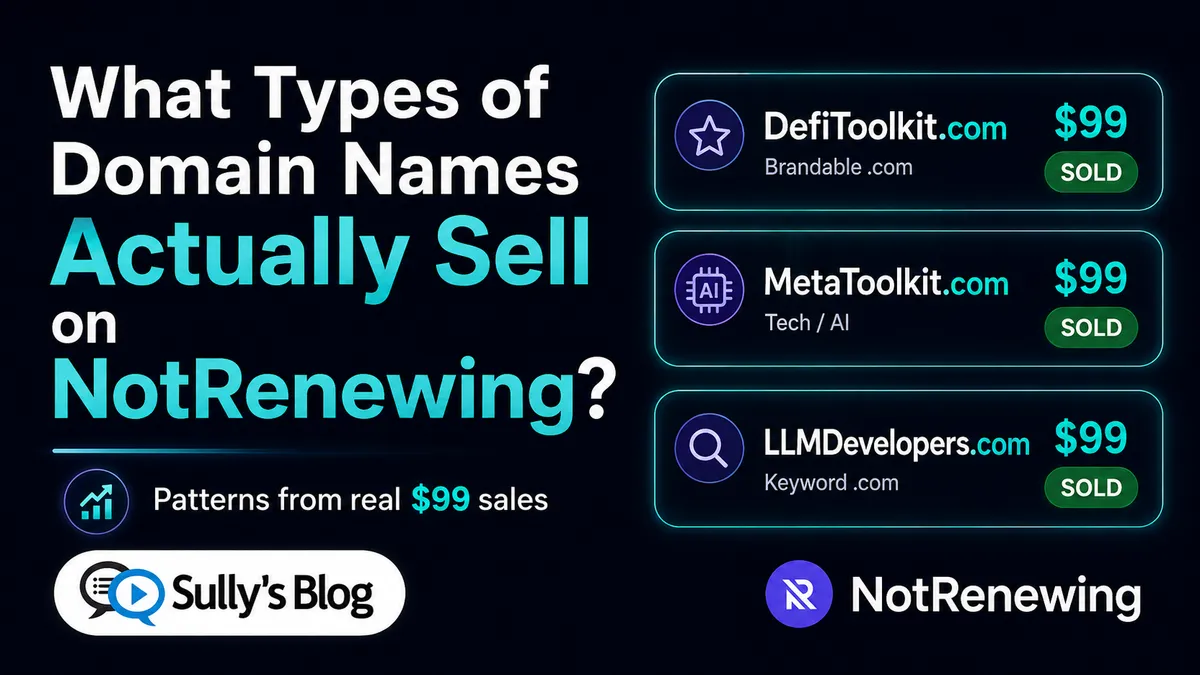
NotRenewing recently crossed 500 sales, which gave me enough data to answer a question I have been curious about since launching the site.
What types of domain names are people actually buying?
Not what we think should sell. Not what gets the most comments on a domain forum. Not what looks good in a portfolio. What are buyers actually willing to pull out a credit card and pay $99 for?
As of August 6, NotRenewing had recorded 523 paid transactions involving 520 different domain names. Those names came from 151 sellers and were purchased by 117 buyers.
More importantly, those sales came out of 20,824 total listings.
That gives us a pretty good sample to start looking for patterns.
And there definitely are patterns.
First, the Uncomfortable Number: About 1 in 42 Names Sells
Before getting into what sells, it is worth looking at what does not.
Of the 20,824 domains that have been listed on NotRenewing, 496 individual listings sold. That works out to a 2.38% sell-through rate.
Roughly one out of every 42 domains listed finds a buyer.
Keep in mind that every domain is $99.
There is no $2,500 asking price getting in the way. There is no negotiation. There is no seller turning down a $500 offer because he thinks the domain is worth $5,000.
The price barrier has essentially been removed.
And 41 out of 42 still do not sell.
I actually think that is one of the more useful pieces of data I have seen since launching NotRenewing because it reinforces something domain investors sometimes forget.
Cheap does not make a bad domain good.
If nobody wants the name at $99, the problem probably is not the price.
So what separates that one name from the other 41?
There is no single answer, but a few things stand out.
Shorter Names Have a Clear Advantage
This is probably the cleanest pattern in the entire dataset.
Here is the sell-through rate based on the length of the domain, not counting the extension:
1 to 5 characters: 3.00%
6 to 8 characters: 2.92%
9 to 12 characters: 2.70%
13 to 16 characters: 1.51%
17 or more characters: 1.03%
There is no reversal anywhere in that progression.
As the names get longer, the sell-through rate drops.
A domain with 17 or more characters was about one-third as likely to sell as a domain with five or fewer characters.
That does not mean every five-letter domain is good. There are plenty of five-letter combinations I would not register for $10, let alone buy for $99.
It also does not mean long domains cannot sell. I will get to some very interesting exceptions in a minute.
But if you are reviewing a portfolio before renewals and deciding which names deserve one last shot, length should absolutely be part of the equation.
Buyers consistently lean toward names that are shorter and easier to process.
Some of the shorter names sold include:
Mazed.com
Zebli.com
Cezza.com
Klap.ai
Gum.gg
Grads.io
Boast.dev
Begin.vc
Soak.me
Wynd.co
Petal.cc
There are dictionary words in there, brandables, acronyms, and made-up words. They are not all the same type of domain.
What they have in common is that you can look at them quickly and absorb them quickly.
That matters even more on a marketplace where buyers are scanning a constantly changing list.
The Name Still Has to Mean Something
Length alone does not explain the sales.
One of the patterns I see over and over in the sold list is that buyers seem to like names where a possible use comes to mind quickly.
Take some of these:
HealingTips.com
MachineHelp.com
PaymentChat.com
LushHair.com
LawDaily.com
DriverDash.com
NameTutor.com
BulkPayments.com
OrganicJeans.com
ValleyWallet.com
PracticalCRM.com
WiFiDefender.com
These are not necessarily domains that would sell for six figures.
That is not the point.
You can look at each one and come up with a business, product, website, service, or project that could use it.
There is very little explaining required.
HealingTips.com sold about 30 minutes after it was listed.
MachineHelp.com sold in roughly 36 minutes.
PaymentChat.com sold in a little over four hours.
DriverDash.com took about nine hours.
LushHair.com sold in less than twelve hours.
LawDaily.com sold in about twelve and a half hours.
That is something I would pay attention to if I were deciding which names in my own portfolio to keep renewing.
Ask yourself:
If someone sees this domain in a list of 100 names, do they immediately understand what it could be used for?
If the answer requires a paragraph of explanation, that is probably not a good sign.
Long Domains Can Sell When the Commercial Use Is Obvious
This was one of the more interesting things I noticed when I went through the individual sales.
The overall numbers clearly say shorter is better.
But there is a group of longer domains that performed surprisingly well.
Look at these:
WashingtonPlumber.com
JacksonvilleRehab.com
HartfordLandscaping.com
AtlantaRemodel.com
NewYorkMatchmaker.com
TallahasseePhotography.com
Those are not short domains.
WashingtonPlumber.com is 17 characters before the .com. It sold in a little over two hours.
JacksonvilleRehab.com is also 17 characters. It sold in under three hours.
HartfordLandscaping.com is 19 characters. It sold in about three and a half hours.
AtlantaRemodel.com sold in roughly nine hours.
NewYorkMatchmaker.com sold in about twelve and a half hours.
TallahasseePhotography.com is 22 characters long and still sold in less than a day.
Why?
My guess is because there is almost zero ambiguity about what these names are.
Nobody has to sit there wondering what WashingtonPlumber.com could possibly be used for.
A plumber serving Washington is obvious. So is a landscaping company in Hartford or a matchmaker in New York.
This is an important distinction.
Short is better when all other things are equal. But a longer name with an obvious commercial application can beat a shorter name that has no clear use.
That is why I would not use length as an automatic renewal rule.
A 19-character geo-service .com can still make sense because there may be an actual business at the other end of it.
A random 19-character brandable probably has a much tougher road.
Real Words Continue to Attract Buyers
There were 102 sold domains flagged as dictionary words, nearly 20% of all transactions.
Some examples:
Evaporate.net
Mazed.com
Curcumin.net
Hauler.co
Discuss.gg
Kitchen.gg
Justice.gg
Grads.io
Abstain.ai
Zoom.dev
Height.si
Depth.si
Blend.si
Heaters.org
Boast.dev
Attain.dev
Internet.im
Begin.vc
Soak.me
Again, the extension varies quite a bit.
That tells me the appeal of a strong word can sometimes overcome the fact that it is not a .com.
If somebody likes the word enough and the extension is usable, $99 becomes an easy decision.
There is also a branding advantage to these names. A word like Hauler, Justice, Kitchen, Begin, or Boast gives a buyer something to build around.
There is already meaning attached to it.
That is very different from an invented name where the buyer first has to decide whether he even likes the sound of the word.
Brandables Sell Too, but They Tend to Be Clean
That does not mean invented names are dead.
Quite a few short brandables sold as well.
Names like:
Roxely.com
Zatton.com
Zebli.com
Ovixa.com
Nuvemo.com
Voleria.com
Finati.com
Renamely.com
Kanvy.com
Ozebo.com
What I notice about many of these is that they are pronounceable.
They look like they could be company names.
They do not require strange spelling gymnastics to figure out how to say them.
That is a pretty basic point, but it becomes more important when you compare the sold names against the thousands that did not sell.
There is a huge difference between a made-up word that feels like a potential brand and a random collection of letters that happens to be available.
Domain investors sometimes blur those two together.
Buyers apparently do not.
.Com Produces the Sales, but Some Alternative Extensions Have Better Sell-Through
About 71% of all sales were .com.
At first glance, that sounds exactly like what you would expect.
But .com also represented about 82% of the inventory.
The sell-through rate for .com was 2.08%, slightly below the marketplace average of 2.38%.
Several alternative extensions converted at much higher rates:
.gg came in at 25%.
.ai was just over 20%.
.im was about 15%.
.tv was nearly 14%.
.dev was just under 10%.
.io was a little over 8%.
Those samples are much smaller than .com, so I would not look at this and conclude that everyone should suddenly start buying .gg domains.
What I think it does show is that good words in the right alternative extension can be very liquid at the right price.
Look at names such as:
Keyword.bot
Kitchen.gg
Boast.dev
Attain.dev
Begin.vc
Internet.im
Testosterone.now
Recorder.app
Grads.io
There is often some relationship between the word and the extension, or at least a combination that is easy to imagine someone using.
Keyword.bot makes sense.
Recorder.app makes sense.
Begin.vc makes sense.
That is different from taking an average phrase and sticking a random extension behind it simply because the registration was cheap.
And the data shows that too.
Cheap Extensions Do Not Automatically Create Bargains
Some extensions have struggled badly.
More than 500 .xyz names have been listed and the sell-through rate is below 1%.
There were 300 .site names listed without a sale.
There were 172 .media names without a sale.
Another 108 .online names produced no sales.
Remember, these are all being offered for $99.
This is another example of price not being enough to create demand.
If buyers do not really want the combination, taking a domain that might normally be priced at $1,500 and offering it at $99 does not necessarily make it attractive.
The lesson I take from this is not to avoid every new extension.
The opposite, actually. Some are performing very well.
But the bar should probably be higher.
If I am holding a .com, I may be willing to renew a pretty good two-word combination.
If I am holding a less established extension, I want the word on the left side of the dot to be much stronger.
AI Is Selling, but "AI" Is Not a Magic Word
AI has been a major part of the domain market for the past few years, so I was interested to see how it would show up in the data.
Of the names that have been categorized, AI is the largest individual category with 49 sales.
And there are plenty of AI-related names in the sold list:
VoiceASI.com
AgentMash.com
LabServices.ai
VibeCodingBot.com
SavingRobot.com
HackingWithAI.com
AIVoiceBots.com
VisualMCP.com
MCPWrapper.com
MakeGames.ai
LocalAGI.com
AgenticNursing.com
AgenticProfiles.com
AgenticContractor.com
TokyoBot.com
Proofread.app
Hyperscale.bot
The interesting thing is that the demand is not limited to .ai.
Buyers are purchasing AI terms in .com, .io, .app, .bot and other extensions.
There is clearly demand for words such as agent, agentic, bot, MCP, AGI and other terms tied to what is happening in technology right now.
But the overall sell-through numbers are also a warning not to take this too far.
Putting "AI" or "agent" into a domain does not automatically make it good.
There are still far more AI-related names listed than sold.
I think the same basic rules apply. The name needs to be reasonably concise, understandable and connected to something a person might actually build.
Older Domains Show Up More Than I Expected
Another thing I found interesting is the age of the sold inventory.
The median sold domain was almost nine years old.
About 46% of the sold names with known registration dates were at least ten years old.
Nearly 20% were more than twenty years old.
Some of the names dated back to around 1996:
AdvantageMemory.com
Alternative.com
Cyber-Links.com
Others included older names such as PhotoResource.com, Boondox.com, SocialCare.com and Mazed.com.
I would not buy a domain because it is old. Registration age by itself means very little if the name is bad.
What I do think this shows is where some of the better NotRenewing inventory is coming from.
These are domains somebody has been carrying for years, sometimes decades, and has finally decided not to renew.
That is a very different inventory source from somebody sitting down tonight and hand registering 200 available domains.
There are still good names buried in old portfolios.
The owner may simply have reached the point where the renewal no longer makes sense.
Numbers and Hyphens Barely Show Up
There are always exceptions in domaining, but this one is pretty clear.
Only five sold names contained a hyphen.
Only eight contained a number.
That is 13 transactions out of 523.
Again, this does not mean numeric domains cannot have value or that a good hyphenated domain will never sell.
But for this particular pool of buyers at this particular price point, neither has been a major part of the demand.
If I were looking through 1,000 names before renewal and trying to reduce the portfolio, a weak hyphenated or numbered name would need a very good reason to survive the cut.
The Best Names Usually Pass the Five-Second Test
After going through all of these names, I keep coming back to something that is hard to turn into a spreadsheet column.
The names that sell tend to be easy to understand.
Sometimes they are short dictionary words.
Sometimes they are two-word .com domains.
Sometimes they are pronounceable brandables.
Sometimes they are long geo-service domains.
Sometimes they are a strong word paired with a newer extension.
They do not all look alike.
But many of them pass what I would call the five-second test.
You see the domain and pretty quickly understand why someone might want it.
CloudCare.
HealingTips.
MachineHelp.
LushHair.
WashingtonPlumber.
There is not much work required to imagine the buyer.
That may be more useful than trying to come up with a rigid formula for the perfect domain.
What I Would Do Differently When Reviewing My Own Portfolio
The data has definitely changed how I look at my own renewal decisions.
If I were going through a large portfolio today, I would give extra weight to:
Shorter names.
Clean, pronounceable brandables.
Dictionary words.
Two-word combinations with an obvious business use.
Geo-service .com domains where the end user is easy to identify.
Strong words in alternative extensions that actually fit the extension.
Names tied to active technology trends where the combination still makes sense without forcing it.
And I would be much tougher on:
Very long names without an obvious commercial use.
Awkward brandables.
Weak names registered mainly because the extension was cheap.
Hyphenated names without a compelling reason for the hyphen.
Number combinations without a specific market.
Trend names where the trend is doing all of the work and the actual domain is weak.
The biggest lesson from the first 500 sales is probably the simplest.
Buyers are much more selective than sellers.
Sellers look at a portfolio and see potential.
Buyers look at a list and decide whether one particular domain is worth $99 right now.
Out of every 42 names listed on NotRenewing, roughly one has passed that test so far.
My goal with the next 500 sales is not simply to get more names onto the marketplace.
It is to get more of the kinds of names buyers have already shown us they want.
Because after 500 sales, we are starting to have something more useful than opinions.
We have their buying history.
Data in this article covers NotRenewing sales through August 6, 2026. The dataset includes 523 paid transactions. Of those, 488 had fully completed transfer as of the reporting date, with the remainder failed, pending or disputed. Want more specifics? See this NamePros article.