



I've renewed names I knew were dead. Not by accident, either. The invoice showed up, I skimmed the list, and I clicked renew because clicking renew was easier than admitting I'd wasted the money two years earlier.
That's most of the problem right there.
Everybody already knows the theory. Cut the weak names, keep the good ones, stop paying rent on assets that will never produce. Nobody argues with that. Then renewal season hits and somehow the portfolio got bigger again.
Dropping a name feels like admitting you were wrong, so you go looking for reasons not to. You remember why you bought it. You remember the buyer you were positive would eventually turn up. Four years of silence later you're still telling yourself the market hasn't caught on yet.
Sometimes that's actually true. Good domains do sit for years before the right person walks in. The job is separating patient from stubborn, and the test I keep coming back to is embarrassingly simple. If this name were sitting unowned in a registrar search box right now at reg fee, would I buy it today?
When the answer is no, I already have my answer. I just don't want to hear it.
Start with the reason you bought it in the first place. Every name in your portfolio had one, even if it was a bad one. Strong two-word .com. Fits an industry that's growing. Real traffic, real backlinks, an obvious set of companies who could use it. Short, clean, spells itself. Whatever it was, ask whether it still holds up.
Sometimes it does. The category kept growing and the name still sounds like something a real business would put on a truck. Other times the trend died, the technology moved, or the buyer pool was always smaller than you talked yourself into believing.
Then ignore what you've already spent on it. All of it.
If you've put $60 into renewals over five years, that money's gone. It has no vote in whether you spend another $12. This is where investors get stuck, because dropping the name feels like throwing away everything that came before it. Renewing a bad name doesn't recover the old money. It just adds to it.
The only question that matters is whether the name can produce a return starting from today.
Read the whole domain, not the good part of it. A valuable keyword doesn't rescue an awkward phrase. Plenty of names have AI or solar or homes or crypto sitting inside four other words that nobody would ever type. Buyers don't buy keywords. They buy names.
So say it out loud. Would a company actually use it? Would it look right in an email address, on a business card, as an app icon? Is the word order how a person would say it? Is the spelling obvious to someone hearing it over the phone?
If you need a paragraph to explain why the name works, it probably doesn't.
Next, look at whether anyone has ever cared. Sales aren't the only signal, but some kind of interest should exist by now. Inquiries, landing page traffic, offers, clicks, replies to outbound. One lowball offer doesn't prove much. Repeated interest from unrelated people over time does.
A domain that's been priced sanely, put in front of buyers, and gone completely quiet for years has told you something. Believe it.
Then compare what it costs to hold against what it might actually bring. A $10 renewal isn't automatically cheap and a $70 renewal isn't automatically expensive. What matters is the gap between carrying cost and a realistic sale price, not a dream sale price.
A $10 name with a believable $2,000 retail ask and a decent list of end users is worth another year. A $70 premium renewal on something that'll sell for $500, if it sells at all, isn't. Premium fees are the ones that really deserve a hard look, because that surcharge follows the name forever. Add up five years of it. Would you buy the domain today if you had to hand over that number upfront?
Be careful with comps, too. Comparable sales help, right up until you start reaching. Same keyword doesn't mean comparable. Extension, length, word order, commercial use, who the buyers were, all of it changes the picture.
You can find one big sale that makes almost anything look promising. That's the easy part. The harder and more useful work is figuring out how often names like yours sell at all. Twenty sales between $1,000 and $3,000 tell you more than a single $25,000 outlier ever will.
Now count the buyers. Not categories. Actual companies, products, services, organizations. Sit down and write names.
Ten or twenty legitimate prospects, and the domain has enough reach to justify another year. If you can't get to three without stretching the definition of prospect, that's your answer.
Check the legal exposure while you're in there. Some names aren't worth renewing because the downside is bigger than the upside. Anything sitting close to a company, product, celebrity, or slogan is a liability you're paying to keep, and new trademarks show up all the time. Run a fresh search on the ones that made you slightly uneasy when you registered them. A shaky name isn't an asset just because somebody out there might pay for it.
And then there's the money you're not spending elsewhere. A hundred weak names at $12 is $1,200 a year. That's a handful of better domains, or outbound, or tools, or just cash sitting there for when something good comes up.
Portfolio size turns into a vanity metric fast. Five thousand names isn't better than fifteen hundred. I've watched people brag about counts while their renewal bill quietly ate their entire year of profit.
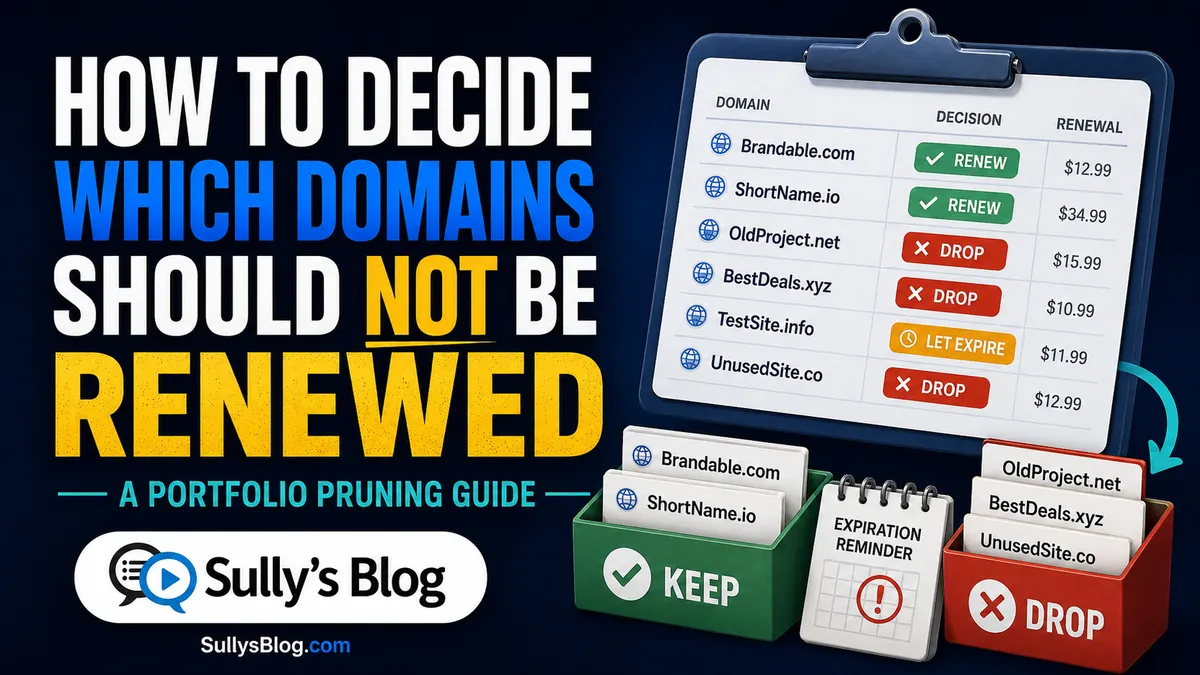
You don't need a scoring model for any of this, but you do need to be consistent. Look at quality, interest, comps, cost, risk, and whether the name is still relevant to anything happening now. Then put it in one of three piles. Renew, no discussion. Look harder. Gone.
The middle pile is where the real work lives. Those aren't obvious drops and they aren't obvious keeps, and if you're not careful the middle pile becomes a witness protection program where every questionable name survives another year under a new identity. Give yourself a deadline. Research it, reprice it, promote it, contact a few buyers, then decide.
For anything headed to the drop list, give it one last shot at selling first. A name you don't believe in can still be worth something to an investor, a developer, or an end user at the right price.
Lower it to a real liquidation number. Post it. Put it on a clearance page. Email a few logical buyers. Bundle related names together so somebody gets a reason to bother.
This is the whole reason NotRenewing.com exists. Owners are sitting on names they've already decided not to keep, and other people still see something in them. Listing before expiration gives the name a chance to change hands instead of just vanishing out of your account.
Most weak names will stay weak names. Getting anything back still beats paying another renewal on something you've already given up on.
Just start early. Waiting until the last day leaves no room to price it, promote it, sell it, and transfer it. I'd start the review 30 to 60 days out, minimum.
The hardest part isn't any of the analysis. It's being honest about your own favorites, the names you're convinced the market misunderstands. Sometimes the market is wrong. More often I'm the one who got attached to my own idea and stopped looking at the name.
So ask whether you'd recommend it to another investor at the same renewal cost. Whether you'd buy it from someone else today. Whether you'd tell a friend to keep paying for it.
If not, what exactly are you doing?
Dropping names isn't failure. It's maintenance. The investors I respect aren't the ones who never made a bad registration. They're the ones who spot it, stop the bleeding, and move the money somewhere better.
A purge helps immediately, too. Cash flow improves the same month, the portfolio gets easier to keep track of, and you finally know what you own. It also makes you a better buyer, because once you line up everything you're dropping, the pattern shows up. Too many trend names. Too many long phrases. Too many brandables that sounded clever at 1 a.m.
That list is worth more than most of the names on it.
Go through your renewals with fresh eyes before the next cycle. Forget what you've already spent, look at what's actually there, give the borderline ones a final window to sell, and then let them go.
And try not to check the whois in six months to see who picked them up. I've done that. It never once made me feel better.