



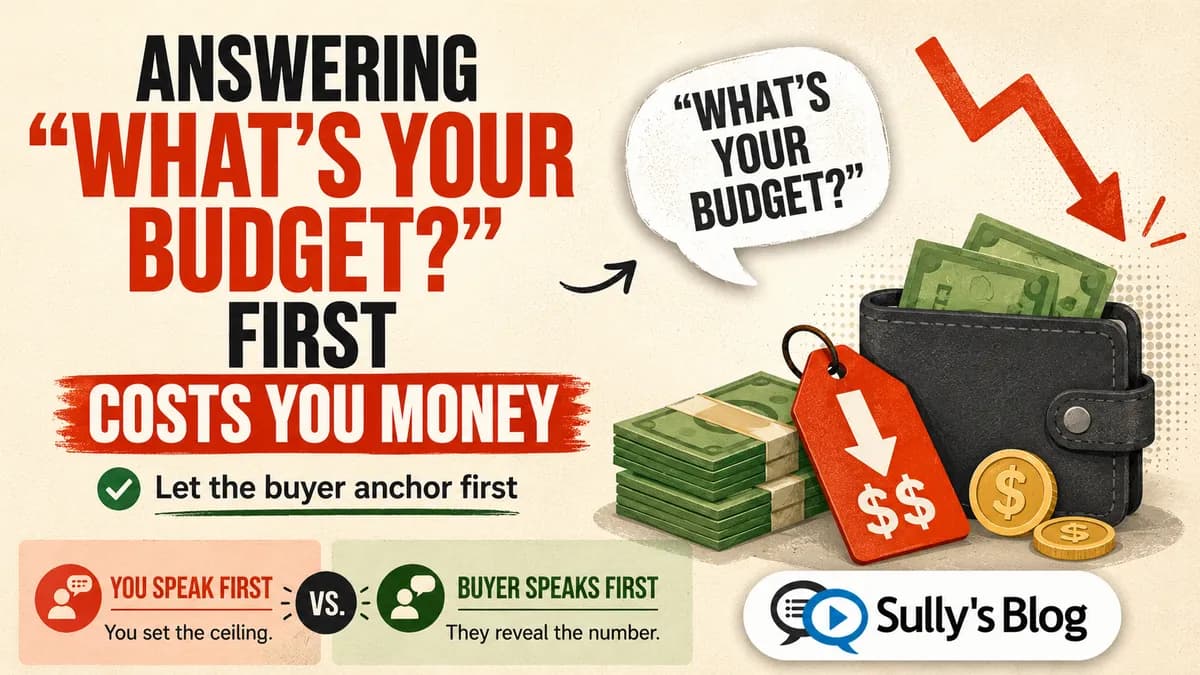
"What's your budget?"
That one can burn you. It sounds harmless. Sometimes it even sounds reasonable. The other side just wants to know if you're both in the same universe before anyone wastes time, right?
Except that's not really what's being asked. The budget question is a request for the most valuable piece of information in the entire negotiation, and people hand it over in the first email because refusing feels rude.
I hear it constantly. Inbound inquiries on my own names, threads on the forums, buyers asking me how to approach an owner. The question shows up in the first or second message almost every time, and it almost always comes from the side that stands to gain by hearing the answer.
Here's how it plays out. You contact a domain owner and ask if a name's available. He responds by asking your budget. You say you can go up to $5,000. Maybe he would've taken $1,500. Maybe the name's been sitting dead for ten years and he'd have jumped at $750. You'll never know, because the conversation now starts at five grand.
Even when he comes back lower, your number is the anchor. "I was hoping for $4,500" suddenly feels like a win because it's under your max. It isn't a win. You might be paying triple what he'd have accepted an hour earlier, and the discount you think you got was measured against a number you supplied.
Domain negotiations are especially exposed to this because there's rarely a clear market price. Two similar names sell for wildly different amounts all the time. One owner's thrilled with four figures while another rejects five without blinking. That uncertainty should be working in your favor. It can't do that if you resolve it for the other guy in your opening message.
When you're buying, you want the owner talking first. Ask for an asking price, a range, whether he's had offers before. His answer tells you how he sees the name. If he says $2,500, fine. Now you know where things start and you can counter, accept, or walk.
Open with "my budget is ten grand" and all of that is gone.
There's also a difference between what you can spend and what you should spend. A company might have $25,000 set aside for an acquisition, but that number usually covers the domain, the rebrand, the legal review, maybe some marketing. Tell a seller the full figure and watch him quietly decide the domain is worth all of it.
Flip it around and the same trap shows up on the sell side. Buyers love asking, "What's your lowest price?" before they've offered anything. Same question, different direction. It's an invitation to negotiate against yourself. If you're asking $8,000 and you volunteer that you'd take $5,000, you've given away three grand and gotten nothing back. No counteroffer, no commitment, nothing. Sellers do this all the time because they want to seem easy to work with. From the other side of the table, "easy to work with" and "cheap" look identical.
The better move is simple. Ask them to put their best offer forward. Then you evaluate it against the name's quality, what you paid, comps, prior inquiries, and how happy you are to keep holding. You don't need to be cagey about it. "I'd like to hear your offer before we talk about flexibility" is a perfectly professional sentence, and in my experience nobody serious walks away because of it.
Sometimes a buyer really does have a hard limit. That's fine. Let the limit shape their offer, not your price. "My offer is $2,000" is a real number on the table. "My budget goes up to $7,500" is a map to everything else in your pocket.
Are there exceptions? Sure. A broker hunting names on your behalf obviously needs to know what you can spend. And if a seller quotes $100,000 and your ceiling is $5,000, disclosing that ends things fast, which is its own kind of useful. Edge cases, though. In a direct negotiation, before the other side has named a price, going first with your maximum almost never helps you.
The question will keep coming. It'll usually arrive in a friendly tone from someone who seems genuinely helpful, because that's what makes it work.
Take a breath before you type the number.