



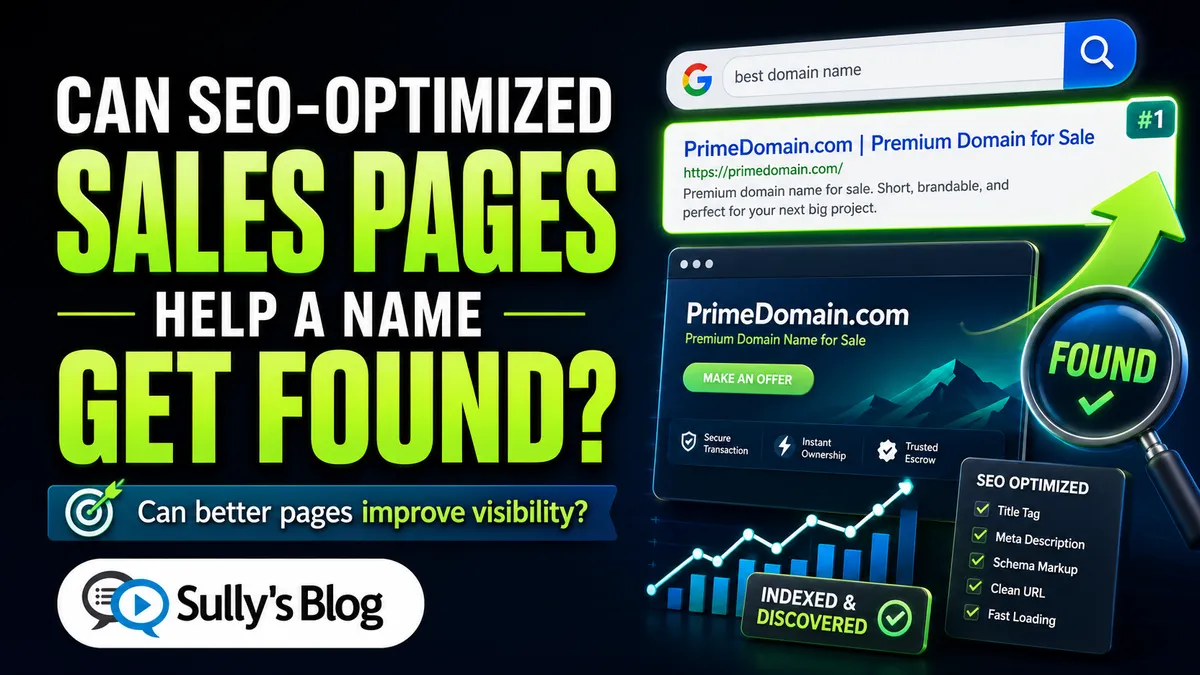
I recently came across a discussion somewhere and I can't recall exactly where. But it was about making domain sales landing pages more visible in Google and AI search. The concern was that most domain landing pages provide very little information. They show the domain, an asking price or inquiry form, and not much else.
That works when someone already knows the domain and types it into a browser. It may not do much for someone searching Google for a name or idea connected to that domain.
This led me to another claim I have seen in before. Some people believe individual sales pages should be placed on a subdomain because Google may treat the subdomain as a separate site.
For example, suppose CryptoAI.com is for sale (I'm sure it's a real name owned by someone). The proposed strategy might create a page at:
sales.yoursite.com/cryptoai-com
The claim is that this page could rank faster than:
yoursite.com/domains/cryptoai
I wanted to know if there was anything to it.
There are domain investors who say optimized sales pages have ranked in Google. That makes sense to me. A page explaining how a domain could be used gives Google more to work with than a page containing only a name and a contact form.
The subdomain part of the claim is less convincing.
Google can treat a subdomain as a separate site, but that does not mean the subdomain automatically receives greater topical authority. It also does not mean pages on it will rank faster. A page located in a directory on the main website may have an advantage because it is more closely connected to the authority, content, and internal links of that site.
A subdomain can still be useful. It can keep a large portfolio of sales pages separate from a blog, company website, or marketplace. It may also make the technical side easier to manage. Those are organizational advantages, not guaranteed SEO advantages.
The bigger opportunity is creating a useful page for each domain.
A sales page for CryptoAI.com could discuss possible uses such as cryptocurrency analysis, automated trading tools, blockchain security, or artificial intelligence products for investors. It could include a unique title, description, asking price, purchase process, and links to related domains.
The content needs to be genuinely different for each name. Creating 5,000 nearly identical pages and swapping out the domain is unlikely to accomplish much. Google may view those pages as thin or repetitive.
There are also some technical details to get right. Each domain should have one primary URL. If the same sales page is available through multiple addresses, redirects or canonical tags should identify the version Google should index. The pages should also be included in a sitemap and connected through sensible internal links.
My conclusion is that individually optimized sales pages are worth testing. They give search engines more context and potential buyers more information.
What I would not assume is that placing those pages on a subdomain creates an automatic ranking boost. The URL structure is probably the least interesting part of the idea. The quality of the page is what gives the strategy a chance to work.