



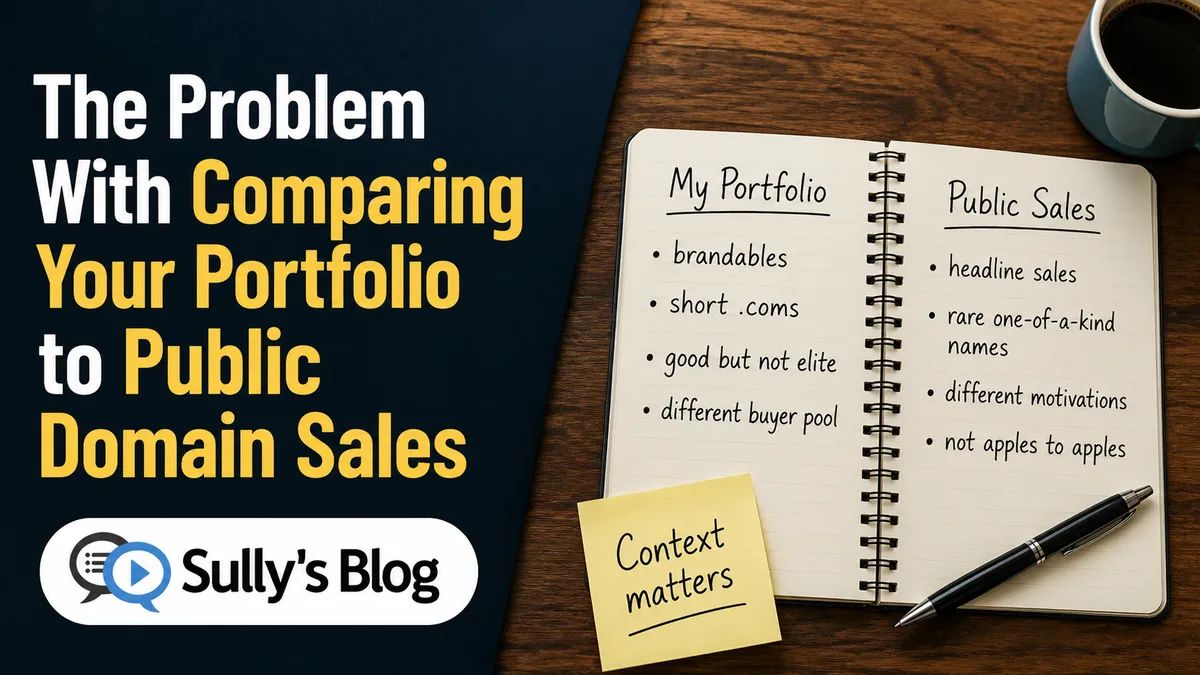
The fastest way to fall in love with a domain you already own is to go find a comp.
You pick up a two-word .com for $300. You run the keyword through NameBio, you spot something close enough that sold for $18,000, and suddenly that $300 looks like the smartest thing you did all month.
I've done it. I'd guess most of us have.
Comps are useful. I check them constantly. They'll give you a range, they'll tell you whether buyers are actually paying for a keyword or just tolerating it, and they keep you from pricing off pure gut.
The trouble starts when we treat reported sales like they're the market.
They aren't.
DNJournal says so right in the header of every chart it publishes. Highest domain sales reported. Their all-time top 20 page carries a footnote spelling out that top tier sales are often wrapped in non-disclosure agreements, so the price might not surface for years, if it ever surfaces at all. The example they use is Tesla.com. That deal closed in 2016 and nobody had a confirmed number until Elon Musk said it out loud in 2018. One of the biggest .com transactions of that stretch sat invisible for two years.
NameBio is the same animal at a different scale. Millions of publicly reported sales going back to the late nineties, and every single record got there because somebody chose to report it. The annual NameBio dollar volume analysis over at NamePros puts a number on the gap. Some estimates suggest only 5 to 10 percent of retail sales ever land in the data.
Sit with that for a second.
That creates two problems for us. The first one's obvious. We're seeing a slice.
The second one's worse. We're studying winners.
Search a keyword and you might turn up ten sales between $5,000 and $30,000. What you won't find are the several hundred near-identical names that got renewed six years running without one serious inquiry. Those never get reported, because nothing happened. Nobody files a report that says nothing happened.
That should change how an acquisition looks.
Say you're scanning the .ai numbers. Blueberry.ai sold for $100,000 at Spaceship this past August. Real sale, real money, sitting right there on DNJournal's year-to-date chart. So you go hunting and you turn up some other soft, friendly, food-adjacent .ai sitting at auction for $500, and the case builds itself. Same extension. Same shape. Same brandable feel. Maybe yours is even shorter.
But you don't know why Blueberry.ai sold.
Maybe the buyer had been operating on a hyphenated workaround for two years and finally closed a round. Maybe it's the exact name of a company that just needed to lock it down. Maybe two bidders got stubborn with each other. Maybe the seller had held it since 2013 and the right person happened to walk in last spring.
The reported price tells you what happened once. It doesn't tell you the odds of it happening twice.
Headline sales make all of this worse, because they're the ones we all see. Bot.ai went for $1.2 million at Sedo back in March, the largest publicly reported .ai sale on record. It currently takes $90,000 just to crack DNJournal's year-to-date Top 100 across all extensions. Those numbers are real and they're worth paying attention to, because they show what the top of the market can do.
They're also nothing like the market most of us actually work in. NameBio recorded roughly 190,300 sales for 2025, totaling a little over $244 million. Run the division and you land somewhere around $1,300 a sale. That's not a clean retail average, and I want to be honest about why. NameBio's sale count is dominated by wholesale, investor-to-investor stuff, which drags it down. But it's still a useful reminder of where the bulk of this business lives, and it isn't anywhere near the Top 100 chart.
Possible and probable are different words.
A record one-word .com sale doesn't turn every one-word .com into a six-figure asset. A $100,000 .ai doesn't set a floor for every decent .ai. And one big sale on a hot keyword doesn't create a market for all the variations of it. Ask anybody who loaded up on crypto keywords in 2018 how the variations worked out.
The better way to use public sales is as evidence, not a verdict.
Ask what a sale tells you about the word, the extension, the buyer pool, and how deep the demand really runs. Then ask the harder one. How many names just like this one never sold at all?
You can't answer that precisely. Nobody can. But asking it out loud has talked me out of more bad buys than any appraisal tool ever has.
Comps are one of the best tools we've got and I'd never tell anyone to ignore them. Just remember what you're looking at.
Those are the names that crossed the finish line.
Your portfolio is still full of names that have to prove they can get there.