



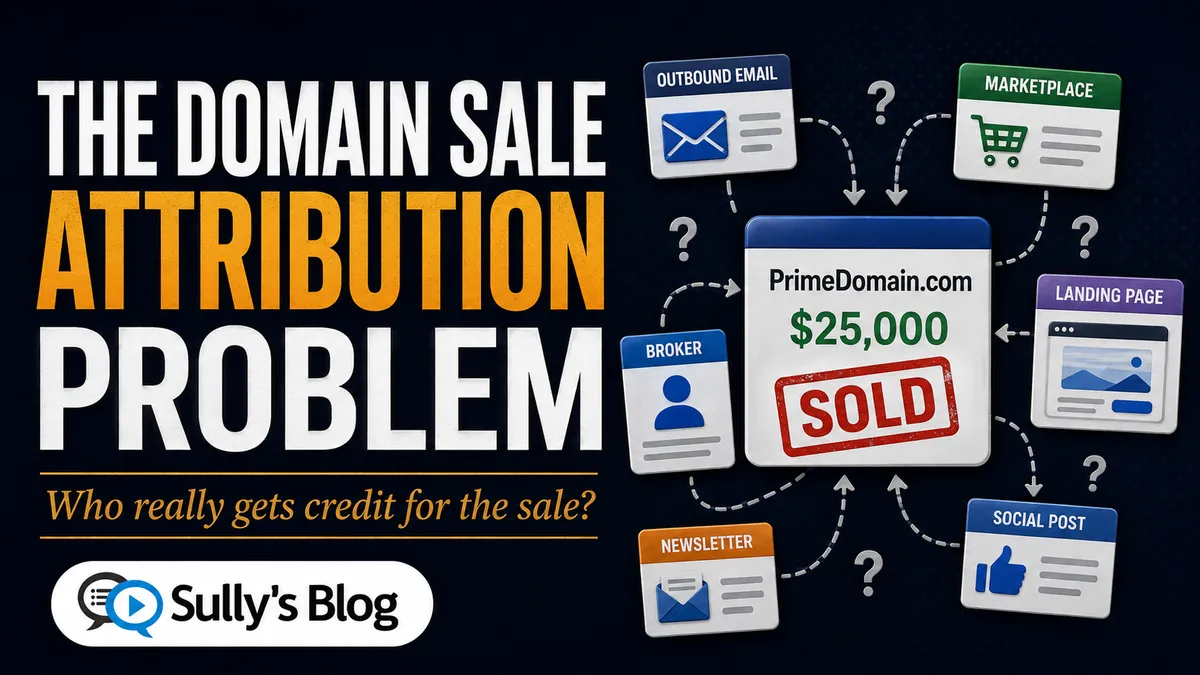
Every domain sale gets credit for happening in the one place we can actually see: wherever the money changed hands.
Sells on Afternic, it's an Afternic sale. Sells on Sedo, it's a Sedo sale. The commission came out there, the transfer happened there, the dashboard says so. Case closed, right?
Not exactly.
The buyer probably didn't start there. They might've stumbled on the name through Google, seen it mentioned somewhere online, gotten an email from you, browsed your portfolio, or run into it on a completely different marketplace first. Where somebody finishes a purchase and where they first noticed the name are two different questions, and we keep answering the wrong one.
That's a real problem, because most of us make portfolio decisions off half the story.
Say you send a cold email about a domain. Nobody writes back. Three weeks later it sells on Afternic.
You'd chalk that up as an Afternic sale and move on.
But what if that email got forwarded around internally? What if somebody pulled up the domain, ran it past a partner, and just used Afternic because it was the easiest way to pay? Afternic closed it. It didn't create the buyer. You did, and you'd never know it.
It works the other way too. Somebody finds the name browsing a marketplace, clicks through to your landing page, and reaches out from there. You'd swear the lander did the work. Really, the marketplace introduced them to the name first.
We hand full credit to whoever's standing at the finish line, because that's the only part of the race we actually get to watch.
This isn't just a marketing buzzword problem. It shapes real decisions.
A few names sell on one marketplace and you start pushing more inventory there. Outbound goes quiet for a month and you decide it's a waste of time. Social posts don't produce a single reply and you stop bothering with them. All reasonable moves, if the credit you're handing out is actually correct.
Most sales aren't a straight line anyway. Somebody sees a name, ignores it, comes back weeks later, checks trademarks, runs it by a partner, visits the site four more times, and eventually makes an offer or hits buy now. That whole thing might take a day. It might take half a year. By the time it closes, nobody, including the buyer, remembers exactly how it started.
Outbound gets judged the hardest on this. Send a hundred emails, hear back from none of them, and most investors call the campaign dead.
Maybe it was. Maybe every one of those emails got deleted on sight.
Or maybe a handful of people opened the domain, looked around, said nothing, and one of them came back through a marketplace two months later. You'd never know, because nobody kept a record of who got the email in the first place.
That doesn't mean every sale after an outbound push should get credited to outbound. It means silence isn't proof of failure. It's just silence.
You don't need a fancy tracking system to fix this. A notebook helps more than people think.
Write down who you emailed, when, and which domain. If that name sells a few weeks later, you've got something to compare it against.
Turn on analytics for your landers if you haven't already. Watch for direct traffic, referral sources, and repeat visits clustering around one name.
When you post a domain on social media, note the date. An inquiry that shows up two days later probably isn't a coincidence, even if the buyer never mentions seeing the post.
Same goes for changes to your own setup. Move a name to a new lander, add a payment plan, list it somewhere new, write the date down. Otherwise you'll never know if the change did anything at all.
And ask people. "How'd you first come across this domain?" is a simple question most buyers will actually answer. Some will say they typed it in cold. Others will mention Google, a broker, an old email, a marketplace listing. Not everyone answers, and some won't remember. One honest answer still beats a dashboard congratulating itself.
None of this means marketplaces don't deserve credit. They bring exposure, trust, financing, payment processing, and a checkout process buyers already know how to use. Any one of those can be the difference between someone walking away and someone paying.
Sometimes a marketplace creates the buyer. Sometimes it just closes a sale that started somewhere else entirely. Often it's a little of both, stacked on top of a Google search and a landing page visit and a price check, with nobody able to say which step actually mattered most.
That's the real issue. We record every sale like it happened in one step, when the buyer usually took four or five.
The receipt only tells you where the money moved.
It doesn't tell you where the buyer started.