



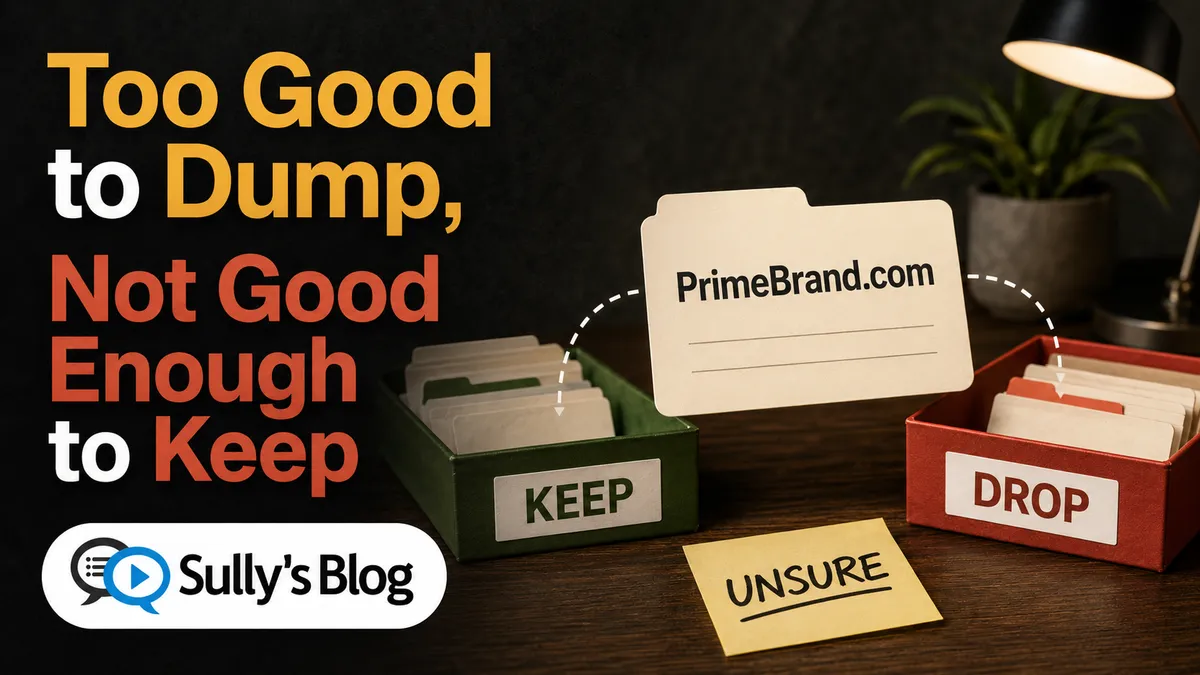
Every investor ends up with a pile of names that don't fit anywhere.
They're not bad domains. Some of them are pretty good. Real commercial meaning, a keyword people actually search for, enough quality that letting them go feels like a mistake.
They've just got one problem. Nobody's bought them.
These are the names that live in the uncomfortable middle of a portfolio. Too good to dump for $50 or $100, not good enough to keep renewing forever without asking a few questions.
I think this is one of the hardest parts of the business, and it doesn't get talked about much because there's no clean answer. Dropping a terrible name is easy. Renewing a great one is easy. The middle is where you actually have to think.
I've got one sitting in my account right now. Two-word .com in the equipment rental space, $340 at auction back in 2019. Good name. I still like it. There was one inquiry in 2021 from somebody who asked for a price and then went quiet forever. A couple of names in the same neighborhood have sold since.
So I renew it. Then another year goes by, and I renew it again.
At some point the question has to change from "is this a good domain" to "is this domain earning its spot." Those aren't the same question, and mixing them up gets expensive. A good domain can still be a bad investment if the carrying cost and the honest odds of selling don't line up with what you'd realistically get for it.
That math is about to get a little worse for everybody. Verisign is raising the wholesale price of a .com from $10.26 to $10.97 on November 1. It's the first increase since September 2024, and it's the full 7% the contract allows. Registrars set retail on top of that, and the ICANN fee sits on top too, so what you actually pay depends on where you keep your names. This is also the first of four possible increases in the current six-year cycle. Verisign has never once passed on taking one. Run it out and wholesale .com is north of $13 before the end of the decade.
Seventy-one cents. Who cares.
Multiply it across a few hundred names, then across the next five or ten years, and you start to care.
The real trap with these middle-of-the-road names is that we price them off what we paid. I spent $500, so taking $150 wholesale feels like admitting I was wrong about something.
The $500 is gone. It's been gone for years.
The only question that matters is whether I'd pay this year's renewal to own the name for one more year. If the answer's no, the $500 doesn't change it. If the answer's yes, renew it and stop agonizing.
Inquiries matter here, but I've learned to weigh them carefully. One inquiry four years ago from a guy who never wrote back isn't proof a buyer is coming. Four inquiries from four different companies is a completely different piece of information. A name that keeps pulling interest is telling you something useful. A name that pulled interest once in 2021 is telling you something too, and it isn't what you want to hear.
Comparable sales work the same way. You can find a vaguely similar sale for almost any domain if you're motivated enough, and we're all extremely motivated the week the renewal notice hits the inbox. That isn't research. That's shopping for permission.
There's nothing wrong with wholesaling a decent name, either. Sometimes taking $250 for something that might sell for $3,000 someday is exactly right. You get capital back and the renewals stop. Then you put the money into a name you like better.
That's inventory management. Every other business on the planet does it without feeling guilty.
The mistake is treating it like there are only two options, hold out for retail or let it expire. There's a third one. Move the money.
I've started thinking of these as names on probation. If something's been sitting for five years, I want a reason to believe the next five will look different. Maybe the keyword is getting more traction, or companies are finally using the term in a way they weren't before. Something.
Usually nothing has changed except the renewal date. That's an answer too.
The easiest way in the world to build a big portfolio is to keep renewing every name that's pretty good. I've done it. I've got a decade of renewal invoices to prove it.
Building a better one means selling names you still like.