



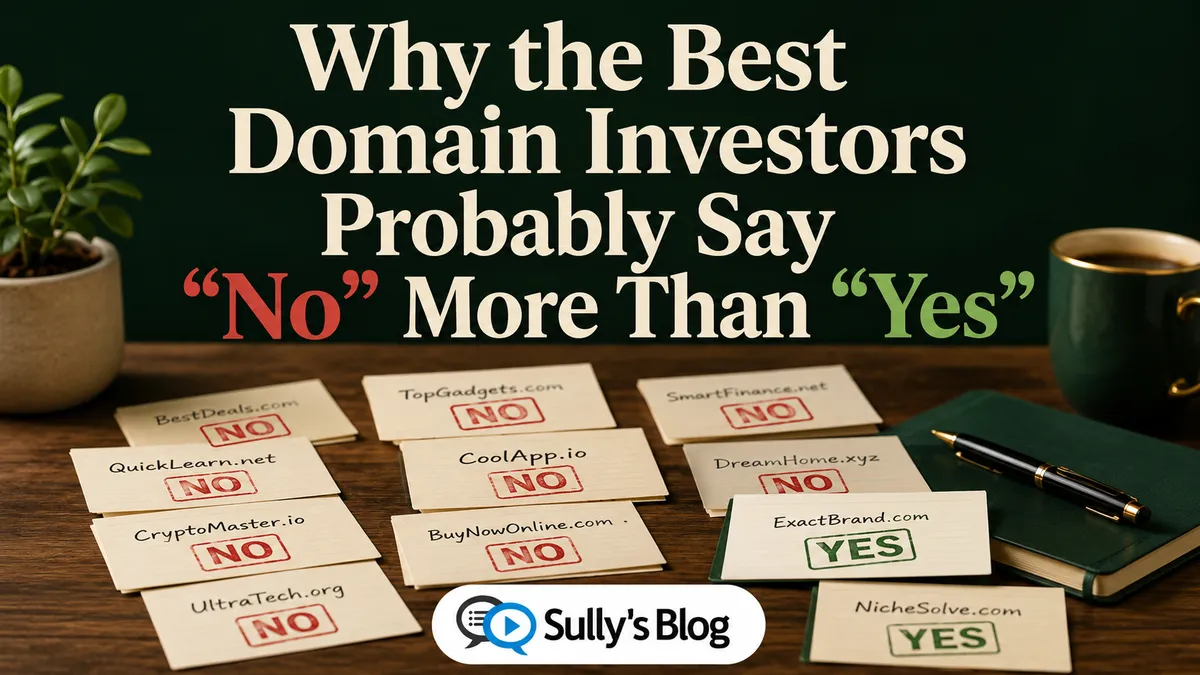
Talking yourself into a domain is the easiest thing in this business.
You spot a name in an expired auction, or you notice it's somehow still available to hand register. Thirty seconds later you're building the case. There are eleven companies using that keyword. The industry's growing. Something in the same neighborhood sold for five grand last year. You're not researching at that point, you're prosecuting, and you already know the verdict.
I've done it plenty. I've done it at two in the morning with a closeout cart open in another tab.
The investors I respect most seem to have flipped that around somewhere along the way. They stopped hunting for reasons to buy and started hunting for reasons to pass. Sounds like a small adjustment. It changes everything about what your portfolio looks like in five years.

There's always another name tomorrow. Another drop list, another closeout, another auction, another idea you can hand register today for about eleven bucks. The supply of things you could buy is effectively infinite. Your renewal budget isn't.
And every name you add is a decision you've signed up to make again next year, and the year after that. Even a plain .com costs you on a schedule. Verisign's wholesale .com price is $10.26 right now, and it goes to $10.97 on November 1. That's just the registry's cut. Add eighteen cents for ICANN and whatever your registrar takes, and what you actually pay is higher. Verisign can take three more 7% bites before this contract cycle is done, which would put wholesale north of $13. Plan accordingly.
One weak domain won't hurt you. Four hundred of them will, and they'll do it quietly, a few dollars at a time, until renewal season shows up and you're sitting there deciding which of your own mistakes to keep feeding.
Which is why filtering might be the most underrated skill in domain investing.
For years my test was "can I picture somebody who'd want this?" That test is worthless. You can picture a buyer for almost anything, especially at midnight with money in the account.
Better question. Would I actually be surprised if nobody bought this over the next ten years?
That one's harder to pass. A name can have real end users and still be a bad buy. Those companies may already own something perfectly serviceable. The keyword might not matter enough to them to justify a five-figure upgrade. The name might need a paragraph of explanation before anybody gets it. Or there are forty near-identical alternatives sitting there available to register, which means nobody ever has to negotiate with you at all.
That's where passing pays.
You don't lose money on a name you didn't buy. You don't renew it six times. You don't reprice it every spring, you don't burn an afternoon writing outbound about it, and you don't spend five Novembers telling yourself next year is the year it finally moves.
Better than that, the money's still there when something genuinely good turns up. It always turns up eventually, and it usually turns up when you're broke.
Newer investors measure themselves by count, and I understand why. Buying feels like working. Watching the list get longer feels like building something real. I used to send myself little mental updates about crossing three hundred names, as if the number was the accomplishment.
The goal eventually turns into something a lot less fun to report. Fewer names, better reasons.
Getting there means saying no when it's uncomfortable. The name that's almost good is the hardest one, because almost is where all the bad math lives. The auction that goes one bid past your number is right behind it, since you can already feel yourself getting ready to justify two more. Then there's the clever brandable that made you grin without ever giving you a buyer you could name out loud.
I still get this wrong. I bought something in June I'll probably drop next year, and I knew better while I was checking out. That part never makes it into anybody's portfolio review.
But the names I'm proudest of owning aren't the ones I won. They're the twenty or thirty I looked at hard, wanted, and left alone. Those don't show up anywhere. No screenshot, no sales report, nothing to post about.
You just quietly have more money than you would have had.