


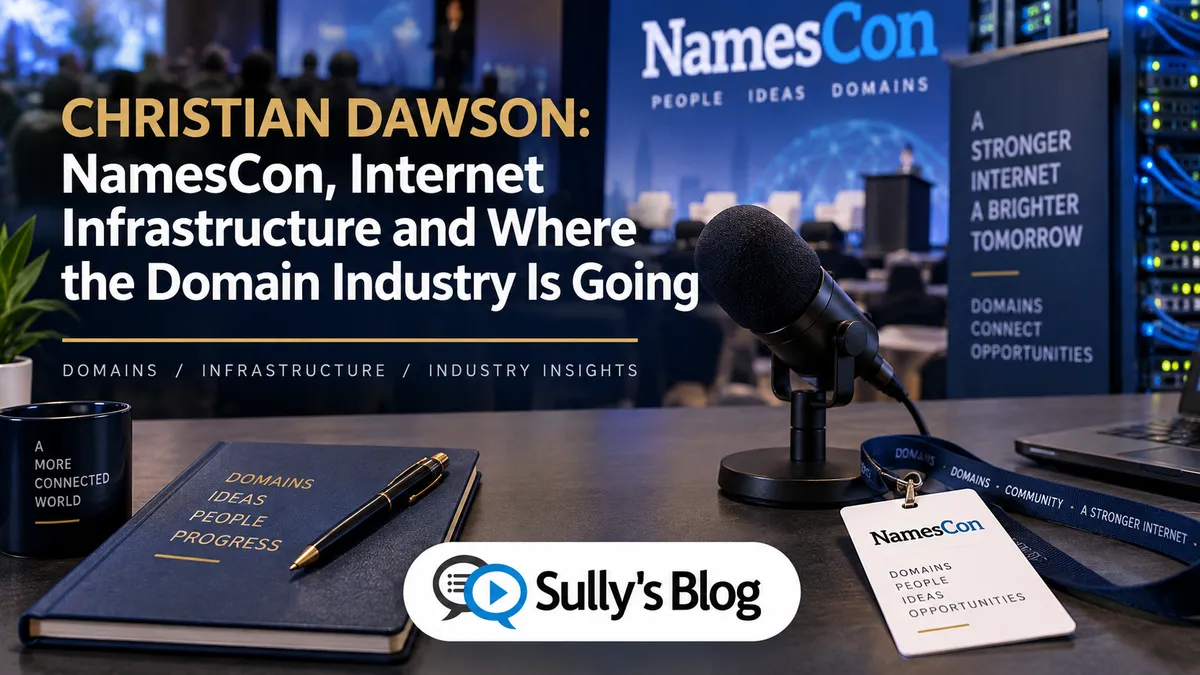
I’ve always enjoyed interviews that give us a chance to step slightly outside the domain investor bubble. Domain names may be the part of the Internet that many of us spend most of our time thinking about, but they sit inside a much larger ecosystem of registrars, registries, hosting companies, cloud providers, policymakers, developers and infrastructure companies.
Christian Dawson has spent much of his career working right in the middle of that ecosystem. He is the co-founder and Executive Director of the Internet Infrastructure Coalition, better known as i2Coalition, an organization representing companies involved in web hosting, cloud infrastructure, data centers, registrars, registries and other businesses that help keep the Internet running. Before i2Coalition, Christian spent 16 years with hosting provider ServInt and was involved in the industry response to SOPA and PIPA that ultimately helped lead to the formation of i2Coalition.
Christian will also be part of the broader community coming together around NamesCon Global this November in Miami. NamesCon takes place November 11-12 at Ice Palace Studios alongside CloudFest Americas, which creates an interesting mix of domain investors and the broader Internet infrastructure community under one roof. If you haven’t registered yet, Sully’s Blog readers can use code SB20 for 20% off a pass at NamesCon.com/tickets.
I thought this would be a good opportunity to talk with Christian not only about NamesCon, but also about where domains fit into the larger Internet economy, how AI may reshape the industry, the changing role of registrars and hosting companies, regulation, digital identity, and what domain investors should be paying attention to over the next few years.
Mike: Christian, for readers who may know your name from NamesCon or CloudFest but aren’t familiar with your background, can you tell us a little about how you got started in the Internet infrastructure industry?
Christian: I got into the Internet infrastructure business almost by accident, right out of college, and then basically never left.
I spent 16 years at ServInt, a hosting company that started in the very early commercial Internet era. We were building hosting services before “cloud” became the language everyone used for infrastructure, and a lot of the business was figuring things out as the Internet itself matured. That meant servers, networks, customers, abuse, security, billing, support, uptime, and all the operational reality that sits underneath websites and online businesses.
Over time, I became increasingly involved in public policy because I started seeing decisions being made by governments that could have very real consequences for the companies actually operating Internet infrastructure. That eventually led to the creation of the Internet Infrastructure Coalition, or i2Coalition, in 2012.
Today, i2Coalition represents companies across hosting, cloud, registrars, registries, data centers and other parts of the infrastructure ecosystem. I also work with CloudFest and NamesCon, and one of the things I enjoy most about that is helping connect communities that are really part of the same Internet economy but don’t always think of themselves that way.
The domain industry is a perfect example. A domain name can look like a standalone digital asset when you’re buying or selling it, but the moment somebody actually uses it, it becomes a gateway into this much larger stack of DNS, hosting, security, identity, applications and services.
Mike: For the average domain investor, what does i2Coalition actually do that ultimately affects them, even if they may not realize it?
Christian: A lot of what we do happens upstream from the moment when a domain investor notices it.
We work on policy and governance issues that affect registrars, registries, hosting providers, cloud companies and other infrastructure businesses. That can include DNS abuse, registration data, intermediary liability, cybersecurity obligations, Internet blocking, privacy, access to data, and the rules governing how infrastructure providers are expected to respond when something goes wrong online.
For a domain investor, those things can sound remote until they suddenly affect how a registrar handles your account, what information you’re required to provide, how a domain can be suspended, what happens when there’s an abuse complaint, or what new compliance costs show up in the services you use.
One of the most important things we try to do is make sure responsibility gets assigned to the part of the Internet stack that can actually do something about the problem.
A registrar can control a domain registration, but it usually can’t control the content on the website using that domain. A hosting company may control the server, but it doesn’t control the registry. A registry operates the top-level domain, but it may have no relationship at all with the person actually publishing content.
Those distinctions sound obvious if you work in the industry, but policy often gets written at a much higher level of abstraction. Part of our job is making sure the real architecture of the Internet is represented when those rules are being made.
Mike: Domain investors tend to think of registrars primarily as places where we register and manage domains. From your perspective, how important are registrars to the broader Internet infrastructure ecosystem?
Christian: Registrars are incredibly important because they sit at a very unusual intersection of identity, commerce, security and infrastructure.
For a domain investor, the registrar is the place where you register names, renew them, transfer them and manage settings. But from the perspective of the wider Internet, registrars are also one of the places where the relationship between a domain and the person or organization controlling it becomes administratively real.
That puts registrars in the middle of some very difficult issues. They’re dealing with customer identity, registration data, abuse complaints, legal requests, account security, DNS configuration and increasingly sophisticated fraud.
They also sit at one of the most sensitive security points in the entire chain. If somebody compromises your registrar account, they don’t necessarily need to hack your website. They may be able to change where your domain points, intercept traffic, alter DNS or effectively take control of your online identity.
So I think the registrar relationship deserves more respect than it sometimes gets. Price matters, especially if you’re managing a large portfolio, but security practices, support quality, account controls and operational competence matter too.
A domain is only as secure as the systems controlling it.
Mike: NamesCon and CloudFest Americas are sharing a venue in Miami this year. What do you think the domain community can gain from being exposed to a broader group of hosting, cloud and infrastructure companies?
Christian: This is one of the things I’m most excited about in Miami, because we’re not just putting two events next to each other. We’re deliberately creating opportunities for communities that overlap economically but don’t always spend enough time talking to each other to actually mix.
The domain community is very good at thinking deeply about names as assets: value, liquidity, branding, marketplaces, extensions, acquisition and sales. The hosting and cloud community is thinking about what gets built after somebody has the name. Putting those communities together creates conversations that don’t happen often enough.
A domain investor may look at a name and ask, “What is this worth?” A hosting company may look at the same name and ask, “What kind of business could be built here?” A developer may ask, “What could an AI agent do with it?” A security company may see an identity surface. A registrar may see a customer relationship that could last twenty years. Those are all views of the same underlying asset.
And that’s reflected in what we’re actually talking about in Miami. NamesCon is digging into digital ownership, the future of search and discoverability, new TLDs, the relationship between registries and registrars, and what happens to domains in an AI-driven Internet. On the CloudFest Americas side, we’re talking about what happens to hosting in an AI-first world, the economics of hosting businesses, cybersecurity, infrastructure and the future of the independent cloud. Those aren’t really separate conversations anymore.
The most interesting opportunities in the next phase of the Internet are probably going to appear between categories rather than neatly inside them. Domains, hosting, AI, identity, payments, security and applications are becoming more interconnected, not less.
That’s why having NamesCon and CloudFest Americas under one roof matters. It isn’t about turning domain investors into cloud engineers or hosting companies into domainers. It’s about giving people access to ideas, companies and potential partners they wouldn’t normally encounter at their own industry event. And because a pass gets you into both, I hope people actually wander across that invisible line and discover something they didn’t come to Miami expecting to find.
Mike: AI is touching almost every part of the Internet economy. Where do you think AI will have the biggest impact on domains, hosting and Internet infrastructure over the next few years?
Christian: I think the biggest change will be that software stops being merely something people use and becomes something that acts.
We’ve spent the first part of the AI boom focused heavily on content generation and answering questions. The more consequential shift is toward agents that can actually do things: purchase services, register domains, configure infrastructure, deploy applications, interact with APIs, manage systems and transact with other agents. That changes a lot for the infrastructure industry.
Hosting and cloud platforms will increasingly need to serve customers that are partly or entirely software-controlled. Registrars may receive domain registrations or configuration changes initiated by agents. Security systems will need to distinguish between legitimate automation and malicious automation. Providers will need to know not just what an agent is doing, but who it is acting for and what it is authorized to do.
It also changes the economics of creating things online. If launching a website, application or service once required a designer, developer, hosting knowledge and several hours or days of work, and an agent can increasingly assemble those pieces in minutes, we’re likely to see far more things being created. That could actually be very good for domains and infrastructure. Lowering the cost of creation generally increases the amount of creation.
The difficult part will be trust. When machines are transacting with machines at enormous scale, identity and authorization become critical. The important question won’t just be “what agent is this?” It will be “who does this agent represent, and what is it allowed to do?”
Mike: There has been a lot of discussion about AI making traditional websites less important because users may increasingly get answers directly from AI platforms. Does that change the long-term importance of domain names, or does it potentially make trusted digital identities even more valuable?
Christian: I think there’s a tendency to conflate websites and domains, and AI may actually make the distinction more obvious. The traditional website may absolutely become less central to some kinds of interactions. If I ask an AI system for an answer and it retrieves information, compares options and completes a task for me, I may never visit ten blue links or browse through a company’s homepage. But that doesn’t eliminate the need to know where information or authority comes from. In some ways it makes that need more important.
A domain name is not just an address for a website. It can be an identity anchor. It connects an organization to email, APIs, authentication, services, certificates, DNS records and other infrastructure. Even if fewer humans manually type domains into browsers, machines still need durable ways to identify resources and determine who controls them.
The Web may become less visually centered around pages while becoming even more dependent on trustworthy machine-readable identity. That doesn’t mean every domain becomes more valuable simply because AI exists. The economic value of individual names will still depend on scarcity, memorability, commercial usefulness, trust and demand. But I would be very hesitant to conclude that the decline of a particular way of browsing the Web means the decline of domains themselves. Those are different propositions.
Join The Sully Report newsletter for monthly domaining advice that challenges conventional wisdom, plus bonus interview content you won’t see anywhere else.
Mike: We are entering another major round of new top-level domain applications. From an infrastructure perspective, do you think the Internet actually needs hundreds or potentially thousands of additional extensions?
Christian: “Need” is probably the wrong test. The DNS can technically support an enormous number of top-level domains. The more interesting question is whether applicants can create extensions that people actually want to use and whether the ecosystem can support them responsibly.
The previous round demonstrated both possibilities.
Some new extensions developed meaningful communities, strong brands or useful market positions. Others never found much demand. That isn’t necessarily evidence that the program failed. Markets discover value partly by allowing people to try things.
At the same time, operating a top-level domain isn’t just acquiring an interesting string. A registry is infrastructure. It comes with security, compliance, abuse-management, technical and financial responsibilities that continue long after the excitement of an application round disappears.
So I don’t look at another thousand possible extensions and ask whether the Internet has room for the strings. Technically, that’s not the interesting constraint. I ask whether the applicants have credible ideas for the namespaces they’re creating and whether they’re prepared for the responsibilities of operating them.
Mike: What lessons should the industry take from the previous new gTLD expansion before this next round gets underway?
Christian: One lesson is that supply does not manufacture demand.
The previous round created a huge amount of new namespace, but simply existing to the right of the dot wasn’t enough to create a successful business. Extensions needed distribution, positioning, registrar support, customer awareness and some reason for people to choose them.
Another lesson is that abuse can’t be treated as somebody else’s problem. Different parts of the domain ecosystem have different responsibilities, but bad actors are very good at finding business models and providers where friction is low. New registries and registrars need to think about abuse patterns from the beginning rather than treating them as an operational issue to solve once scale arrives.
And I think the industry learned that the relationship between registries and registrars matters enormously. A registry can invent a brilliant namespace, but without distribution and registrar engagement it may never reach the market in a meaningful way. That is one reason I’m interested in conversations that bring registries, registrars and users into the same room. They don’t always have identical incentives, but the success of the namespace depends on all of them.
Mike: Governments around the world are becoming much more interested in regulating online platforms and Internet infrastructure. What regulatory issue do you think domain investors should be paying more attention to right now?
Christian: I would pay attention to the growing willingness of governments and courts to use Internet infrastructure itself as an enforcement mechanism. We’re seeing pressure in different jurisdictions around DNS blocking, domain suspension, access restrictions, registration data, identity requirements and obligations on intermediaries. These issues can emerge from copyright, online safety, cybersecurity, fraud, age restrictions or other policy areas.
For a domain investor, the important principle is that a domain sits inside a legal and technical ecosystem. The rules governing registrars, registries and DNS providers can affect the security, portability and use of the asset even if the investor isn’t directly involved in the policy discussion. The key question in these debates is proportionality. If the harmful activity exists at one layer of the Internet, does taking action against another layer actually solve the problem, and what else gets affected? Infrastructure can be a powerful enforcement point precisely because it is foundational. That is also why governments need to be careful when they use it.
Mike: Are policymakers generally getting better at understanding how the underlying Internet actually works, or are we still seeing laws proposed that could create serious unintended consequences?
Christian: Both are true.
There is much greater awareness today that Internet policy has technical consequences. Governments have more technology expertise than they did fifteen years ago, industry engagement is stronger, and the technical community has become much more active in explaining how infrastructure actually works. But the temptation to solve a difficult online problem by imposing an obligation on whichever intermediary is easiest to reach hasn’t disappeared.
That isn’t usually because policymakers are careless. They have a legitimate problem in front of them and a mandate to address it. If harmful activity is hard to reach directly, an infrastructure provider can look like the obvious point of leverage.
The role of our industry is not to respond with “you don’t understand the Internet.” That shuts down a conversation very quickly and often isn’t fair. The useful response is to explain the consequences: what this provider can actually see, what it can control, what happens technically if it takes the requested action, how easily the bad actor can move elsewhere, and what happens to legitimate customers in the process.
Policy gets better when the people who understand the technical system engage early enough to help shape the solution, rather than arriving at the end to complain about it.
Mike: If you were running a small registrar today, where would you look for opportunities to differentiate rather than simply competing on registration price?
Christian: Trust.
Price competition in commodity registration has limits, particularly for a smaller registrar. There will almost always be somebody willing to sell a registration for less. But domains are becoming more important as security and identity assets, and that creates room to compete on things customers increasingly care about: excellent account security, responsive support, clear abuse processes, portfolio management, reliable DNS, recovery when something goes wrong, and integration with the other services customers actually need.
I’d also look very seriously at serving particular communities instead of trying to be everybody’s registrar. A registrar that deeply understands domain investors should build products differently from one serving agencies, SaaS companies, creators, enterprises or AI developers. The domain registration itself may be a commodity, but the customer’s workflow around that registration is not.
And I think AI opens another differentiation opportunity. Registrars have historically been places where humans manually manage names. There is going to be demand for better APIs, delegated permissions, policy controls and systems designed for environments where automated agents may legitimately manage parts of a domain portfolio.
The winning small registrar probably isn’t the one that finds a way to charge ten cents less. It’s the one that becomes indispensable to a particular kind of customer.
Mike: You have watched the Internet infrastructure business evolve for decades. What is happening right now that you think people in the domain industry are underestimating?
Christian: I think the domain industry may be underestimating how quickly the identity of the Internet’s “user” is going to change.
For most of the commercial Internet era, we’ve designed services around a human being sitting on the other side of a browser. Even when software used APIs or automated processes, there was usually a fairly direct relationship between the software and a human-operated account.
Agentic AI complicates that model. We’re moving toward an Internet where autonomous software will discover services, evaluate them, obtain resources, configure infrastructure and communicate with other software. That means a growing share of economic activity online may happen machine-to-machine before a human ever sees the result.
Domains become interesting in that environment because the DNS is already one of the world’s most successful systems for globally distributed naming and delegated control.
I don’t think we know yet exactly how domain names fit into an agentic Internet, and I would distrust anyone who claims the answer is already obvious. But I think it would be a mistake for the domain community to define its future solely around whether humans will continue typing memorable strings into browser bars.
Names have always done more than that. The bigger opportunity is to think about domains as part of the identity, authority and trust layer of the next Internet. That’s a conversation we’re going to be having from a bunch of different angles at NamesCon and CloudFest Americas, with domain people, infrastructure people, AI people and others who may come at the question very differently. I don’t expect us to emerge from Miami having solved it, but getting those communities into the same conversations is exactly where I think we should start.
You can learn more about the work Christian and his team are doing at i2Coalition.com.
NamesCon Global and CloudFest Americas take place November 11-12 at Ice Palace Studios in Miami, and one pass gets you into both. Check out the agenda, then use code SB20 to save 20% off your pass at NamesCon.com/tickets.
I’ll be in Miami, and if you are going too, please let me know. I would love to meet in person.
Disclosure: NamesCon is a Sully’s Blog media partner.