



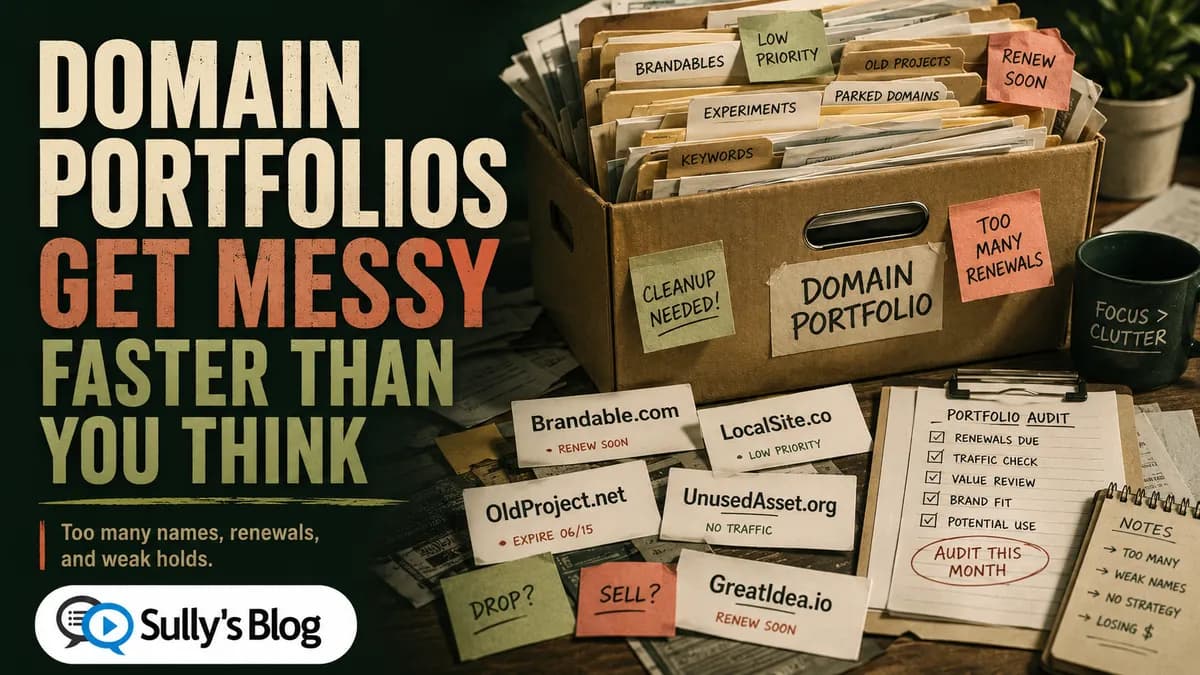
Most domain portfolios don't fall apart overnight. It happens slow enough that you never notice the exact moment it started.
You buy a name, point it to a lander, list it on a marketplace, set a price, and move on with your life. A few years later the domain's still sitting in your account, except almost everything around it has quietly changed.
The price doesn't make sense anymore. The lander's broken. The domain's still listed on a marketplace you stopped using two years ago. Your contact info is stale. You might not even remember what you paid for it, or why you bought it in the first place.
I call this portfolio entropy.
The longer you're in this business, the more your portfolio drifts from whatever organized system you started with. Doesn't matter how good that system was on day one. Once the information attached to each domain goes incomplete, inconsistent, or just plain old, the whole thing gets harder to manage.
Pricing is usually the first thing to rot.
Maybe you priced a name at $2,500 five years ago, based on what the market looked like then. Since then the industry grew, comps sold higher, the term got more valuable, and you never touched the price. Or the opposite happened: some trend you were betting on fizzled out, and the old number's still sitting there like nobody noticed.
Marketplace listings are their own mess. One price on Afternic, a different one on Sedo, a third on your own lander. Sometimes an old listing's still live after you've changed strategy entirely, or even after the domain already sold. That's the kind of thing that stalls a deal or makes a buyer wonder if you're even legit.
DNS and landing pages need the same attention, and they almost never get it. It's easy to assume everything resolves fine because it worked the day you set it up. Nameservers change. Marketplace systems change. SSL certificates expire. Forwarding breaks for no reason anyone can explain. Inquiry forms quietly stop delivering email, and you don't find out until a deal already walked.
I've found domains sitting in my own portfolio that were supposedly for sale and led straight to an error page. Nowhere to click, nowhere to write, nothing. A buyer can't purchase a domain they can't find a way to actually contact you about.
Transfer readiness is the one everybody forgets until it's too late. A domain sitting under a transfer lock, close to expiring, parked at some registrar you barely remember opening an account with, ownership records that don't quite match. None of that matters until a buyer shows up ready to close. Then it matters immediately, and usually at the worst possible moment.
None of this requires anything fancy to fix, just some discipline. Once a quarter, pick a chunk of your portfolio and actually look at it: click the lander, check the price, see if the marketplaces still agree with each other, make sure your contact info works and the domain's actually eligible to transfer, and jot down what you paid and when it renews.
You don't have to audit the whole portfolio in one sitting. Work through it in batches, a little at a time, and eventually you've covered everything.
Most of us spend our energy hunting for the next good name. Sometimes the bigger win is just taking care of the ones already sitting in the account.
A portfolio isn't a static list. It's a living system, and left alone, it decays exactly the way anything else does when nobody's watching it. Entropy always wins. The only question is whether you're checking in often enough to slow it down.